
Predicting a viral outbreak before it reaches the clinic is one of the most significant challenges in modern public health. Traditional surveillance often relies on clinical testing, which can be subject to reporting delays and asymptomatic underreporting. To bridge this gap, the Health Insights team at EpiLumen has been developing proactive, data-driven solutions to turn biological signals into actionable intelligence.
For a recent healthcare client, Prasann Ranade, a Data Analyst on the Health Insights team, spearheaded the development of an advanced early-warning surveillance system using wastewater-based epidemiology (WBE). By leveraging the unique biological signatures found in community sewage, Prasann engineered a forecasting pipeline that provides an 8-week outlook on potential viral surges.
A Unique Opportunity in Data
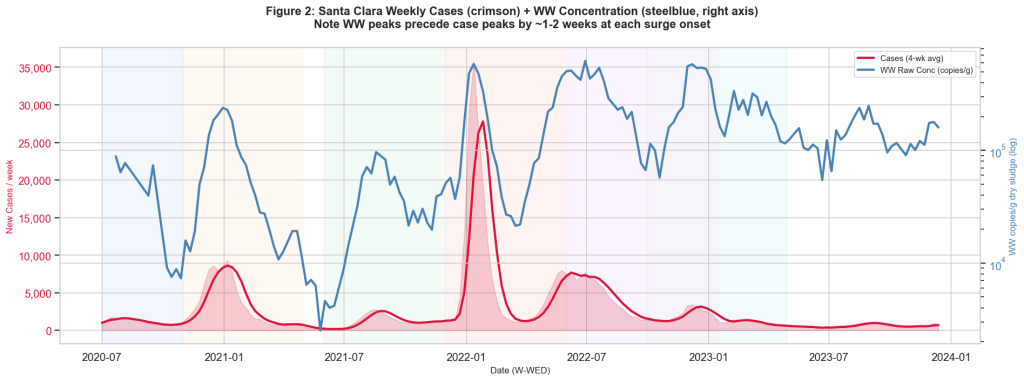
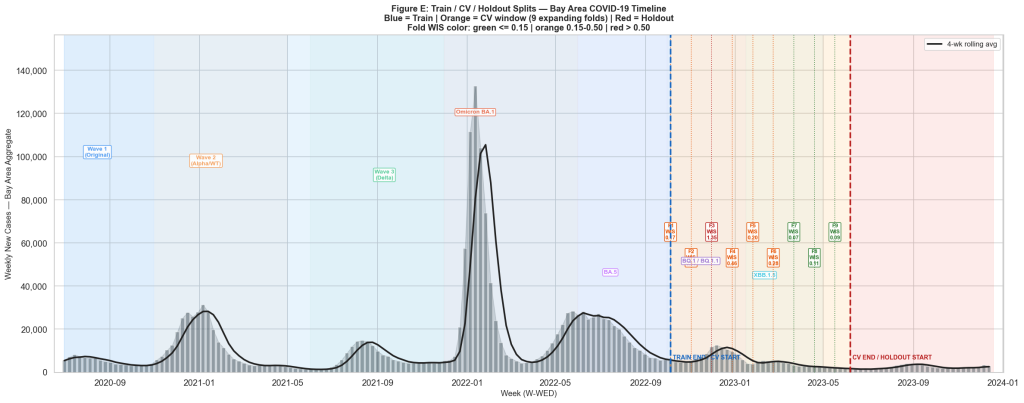
This project provided EpiLumen with a rare and invaluable opportunity to explore a high-fidelity longitudinal dataset. The model was trained on 3.5 years of matched wastewater concentration and COVID-19 case data from the nine-county San Francisco Bay Area, spanning multiple distinct epidemiological waves—from the ancestral strain to the volatile Omicron period.
This dataset allowed the team to test the “Lead-Time Hypothesis”: the idea that sewage RNA concentration serves as a statistically reliable leading indicator of clinical cases. By utilizing a Temporal Fusion Transformer (TFT)—a sophisticated, attention-based deep learning architecture—the system successfully learned to navigate the complex, non-linear relationship between wastewater signals and clinical reporting. The result is a model capable of identifying community transmission dynamics with a measurable lead time of 7–21 days.
Precision and Probabilistic Forecasting
Unlike traditional models that provide a single, often misleadingly precise number, the system developed utilizes probabilistic forecasting. By producing 7-quantile prediction intervals, the model communicates not just the expected trend, but the level of uncertainty. This is critical during volatile outbreak onsets; it allows health officials to understand when a signal is a genuine surge versus a statistical fluctuation, ensuring that resources are allocated effectively without triggering false alarms.
The Path Forward
This project represents more than just a successful technical implementation; it is a proof of concept for the future of public health intelligence. The ability to process complex, irregular environmental data and translate it into clinical foresight is a core competency that EpiLumen intends to expand.
As EpiLumen continues to grow, the company is actively seeking to partner with public health agencies, hospital networks, and municipal governments to scale these surveillance capabilities. By combining advanced machine learning with robust data engineering, EpiLumen aims to remain at the forefront of infectious disease monitoring, providing partners with the foresight needed to protect community health in an increasingly unpredictable world.
Leave a Reply